
Mathematical Foundations
Logistic regression, Bayesian deep learning, information theory, deep learning calculus, and the probability behind generative models.
Second edition · Real-world deep learning interview problems & solutions
Hundreds of fully solved job interview questions from key AI topics.
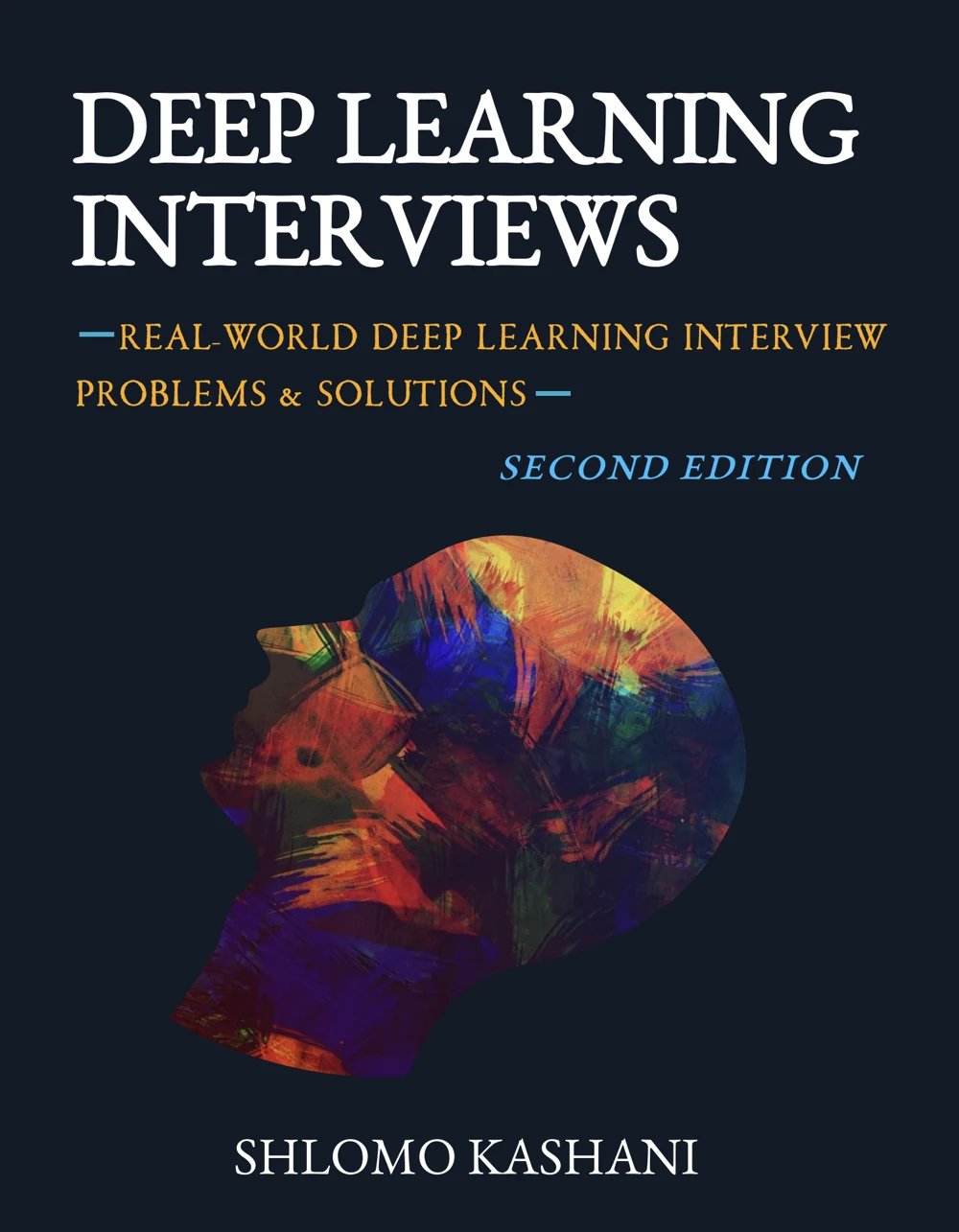
The book
An essential resource for aspiring data scientists and AI professionals facing competitive job interviews or graduate-level exams.
This comprehensive guide provides step-by-step solutions, clear diagrams, and detailed reasoning to make complex concepts intuitive.
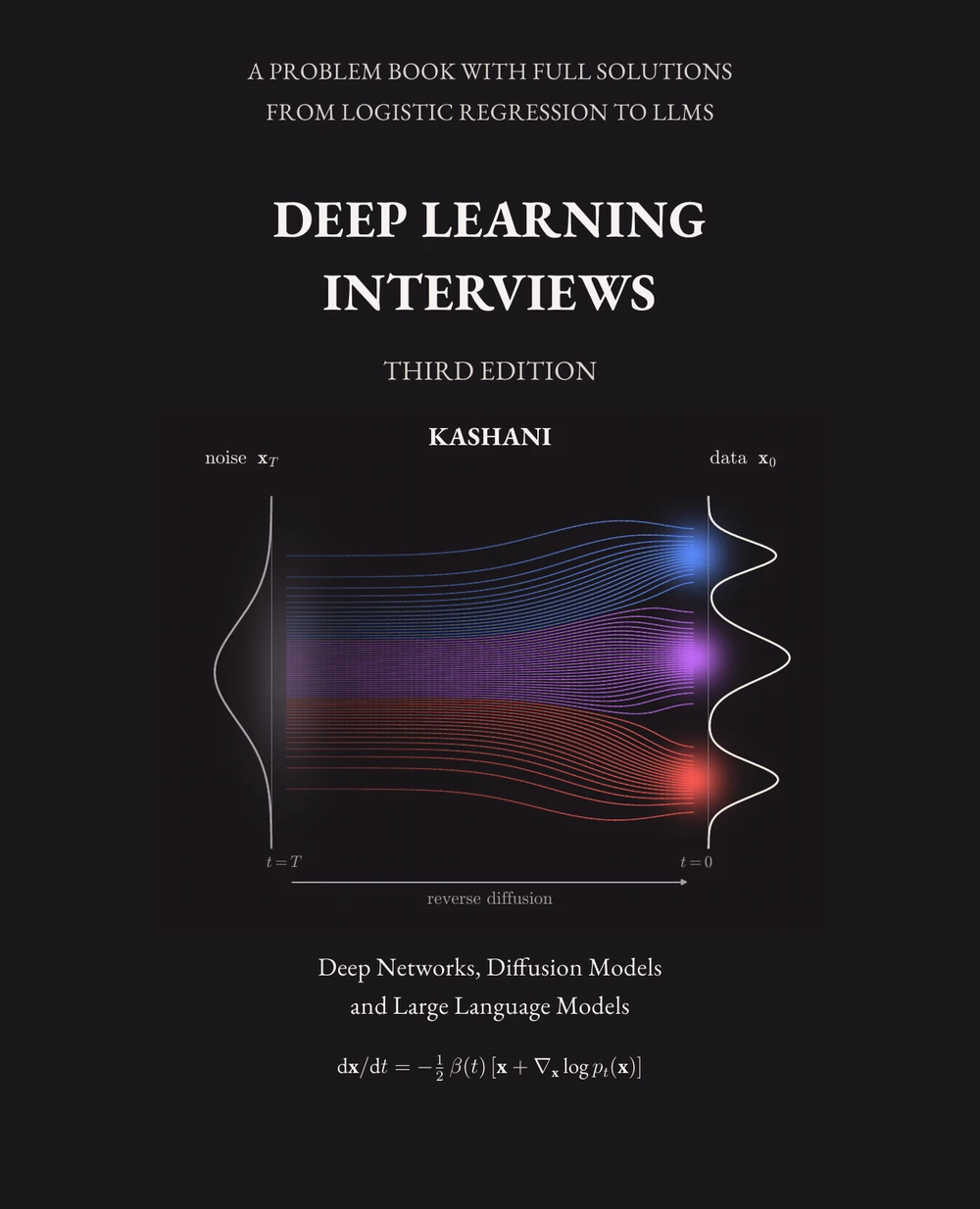
Explore the seven chapters↓Third edition · In preparation
The third edition joins this book with The Art and Science of Generative AI. It keeps the deep learning core and adds diffusion models, large language models, and the engineering that trains and serves them.
Interviewers now ask about forward and reverse diffusion, the KV cache, and how a team aligns and serves a large model. You work each answer out from first principles, line by line.
Every problem now comes with a full solution, derived in numbered equations you can follow with pencil and paper.
Each problem carries a level from 1 to 4 and a role, so you can work the core problems first when an interview is close.
The figures share one drawing style and print in grayscale, so they read the same on paper as on a screen.
Logistic regression, Bayesian deep learning, information theory, deep learning calculus, and the probability behind generative models.
Cross validation and convolution, perceptrons and activation functions, metrics and training, ensembles, feature extraction and transfer learning, and the architectures of generative models.
Generative models and the diffusion idea, stochastic calculus, forward and reverse diffusion, and denoising diffusion in practice.
New in the third editionAutoregressive language models, tokens and scaling, efficient attention, training at scale, alignment, and the systems that cache, batch and serve a model.
New in the third editionThe third edition is not on sale yet, and its cover may change. The second edition stays available as a free PDF and in print.
A comprehensive curriculum covering the mathematical and computational foundations of deep learning.
Entropy, mutual information, KL divergence, and their applications in machine learning and neural networks.
Chain rule, backpropagation, automatic differentiation, and computational graph optimization techniques.
Probabilistic programming, uncertainty quantification, variational inference, and Bayesian neural networks.
Maximum likelihood estimation, regularization, feature engineering, and classification fundamentals.
Bagging, boosting, random forests, gradient boosting, and model combination strategies.
Dimensionality reduction, PCA, t-SNE, feature selection, and representation learning techniques.
Comprehensive treatment covering neural networks, CNNs, RNNs, attention mechanisms, and modern architectures with PyTorch, Python, and C++ examples.
Extended chapter · 100+ pagesBrowse through the comprehensive content and see the quality of explanations firsthand.
Interactive PDF preview
Prefer a physical working copy? The book is available in two print formats.
About the author

Lead Author & AI Researcher
Shlomo brings extensive experience in deep learning research and education. His passion for making complex AI concepts accessible to students and professionals drives the pedagogical approach of this comprehensive guide. Shlomo is also a filmmaker. His film October 7: The Day is an animated reconstruction of the Hamas-led attack on the kibbutzim and the Nova music festival.
“An essential resource for aspiring data scientists and AI professionals. This meticulously curated inventory empowers readers to speak fluently on AI topics.”— Reader Review